
July 07, 2026
Jakarta’s Response to Shared Megacity Challenges: Disaster Risk and Waste Management

Marulina Dewi, Head of Jakarta’s Bureau for Regional and International Cooperation
In November 2025, Jakarta became the world’s most populous city with 41.9 million people, overtaking Tokyo, which fell to third place behind Dhaka, Bangladesh. The new ranking has highlighted the environmental and sustainability challenges facing Indonesia’s capital, an issue discussed by attendees in April 2026 at the 3rd Global Network for Sustainability (G-NETS) Leaders Summit, a summit designed to share solutions to common urban issues. It was held alongside SusHi Tech Tokyo 2026, Asia’s largest innovation conference.
The Big Durian’s Big Challenge
Known as the Big Durian, Jakarta is facing a growing environmental challenge. Home to more than 10 million people in the city proper and over 30 million in the greater metropolitan area, coastal Jakarta is widely considered one of the world’s fastest-sinking megacities. The main causes are excessive groundwater extraction driven by rapid urbanization, and rising sea levels linked to climate change.
Much of northern Jakarta is built on soft, swampy delta land. Decades of pumping from underground aquifers have accelerated the process. As water is removed, the soil compacts and the land sinks. In early 2026, Indonesian media reported that the National Research and Innovation Agency (BRIN) found some parts of northern Jakarta have sunk by as much as four meters over the past four decades, while the city overall is subsiding at an average rate of around 3.5 centimeters per year. About 40% of northern Jakarta now lies below sea level, and this is expected to reach around 90% by 2030, according to a 2016 study by the C40 Cities Climate Leadership Group.
Flooding has become a frequent and costly problem, especially as sea levels are rising by about 3 millimeters per year. Heavy monsoon rains regularly overwhelm rivers and drainage systems, while high tides push seawater into coastal neighborhoods. Major floods have struck Jakarta repeatedly since the 1990s, according to a 2021 NASA blog post, with devastating floods in 2007 submerging about 70% of the city and displacing tens of thousands of residents.
“Jakarta is highly exposed to flood risk, with 13 major rivers, high rainfall intensity, and the influence of high tides,” says G-NETS Leaders Summit attendee Marulina Dewi, Head of Jakarta’s Bureau for Regional and International Cooperation.

“G-NETS highlights how cities are working to deliver real solutions to global challenges. For Jakarta itself, this has been a very valuable experience,” says Dewi
Large-Scale Infrastructure Development Project Underway to Mitigate Flood Risk
At the G-NETS Leaders Summit, Jakarta Governor Pramono Anung explained how the capital is tackling the problem.
“By 2035, Jakarta will achieve 100% piped water coverage and expand the Jakarta Sewerage System to eliminate unprocessed wastewater,” the governor stated in the SusHi Tech Tokyo 2026 G-NETS Leaders Summit Communiqué. “Through the King Salmon circular model, we will process 438 tons of organic waste annually, integrating advanced flood infrastructure with sustainable resource recovery to safeguard our 11 million residents.”
Even though there are plans to relocate the national capital to Nusantara on the island of Borneo, the government of Indonesia is tackling Jakarta’s environmental challenges with major infrastructure projects. Dewi outlined how the government is using other forms of technology in its struggle. The National Capital Integrated Coastal Development (NCICD) project is a massive infrastructure plan designed to protect Jakarta from worsening coastal flooding, land subsidence, and rising sea levels. Often referred to as Jakarta’s “Giant Sea Wall” project, the initiative combines flood control, coastal defense, water management, and urban development. The project was developed through cooperation between the Indonesian and Dutch governments and has been under planning since the early 2010s.
The NCICD’s Phase A focuses on strengthening and expanding existing coastal dikes and river embankments along Jakarta’s northern shoreline. Later phases involve constructing large offshore seawalls and artificial islands in Jakarta Bay. The project is intended to protect millions of residents from tidal flooding while improving drainage and water infrastructure. Construction on several seawall segments and coastal defenses is continuing, particularly in North Jakarta.
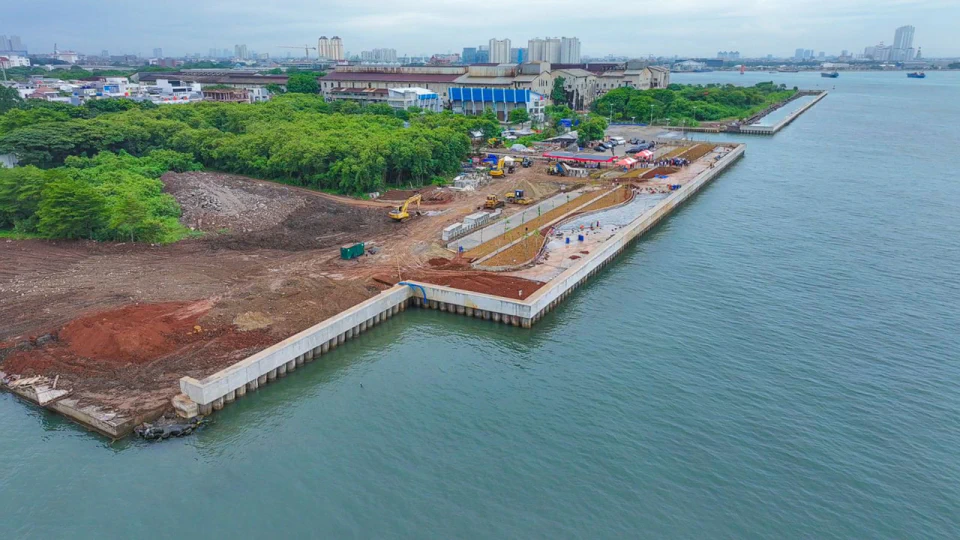
A giant sea wall stretching 500 kilometers is currently under construction. Photo: courtesy of the Special Capital Region of Jakarta
Meanwhile, Jakarta’s JAKI (“Jakarta Kini” or “Jakarta Today”) application has become an important tool in the city’s flood response efforts. Developed by Jakarta Smart City, it provides residents with real-time flood information, including water levels, inundated areas, weather updates, and evacuation-related alerts. Citizens can also report flooding directly through the platform by uploading photos and location data, allowing authorities to respond more quickly to emergencies.
The app integrates data from flood monitoring stations, pumps, and government agencies to help residents track conditions during Jakarta’s frequent monsoon floods. Officials use the information gathered through JAKI to coordinate disaster response, deploy emergency crews, and manage traffic disruptions caused by flooding. The application is part of Jakarta’s broader smart city strategy aimed at improving disaster preparedness and communication between residents and city authorities.
“We are shifting from reactive to a more proactive and preventive disaster management strategy,” says Dewi. “Through these efforts, Jakarta aims to become a safer, more resilient, and more modern city.”
Innovating for a Circular Economy
Another issue Jakarta is dealing with is waste. The megacity generates some 7,000 tons of waste every day, placing increasing pressure on landfills. To help reduce the volume of trash, it has required households to sort their waste for recycling and composting. The four categories are organic waste; inorganic waste such as plastics; hazardous materials; and general waste that cannot be recycled or composted.
To reduce the volume of waste generated by the capital, Jakarta is partnering with the Tokyo Metropolitan Government’s King Salmon Project Overseas Urban Challenges Course. Under the initiative, Japanese startup FOOD REBORN Co., Ltd. has been conducting a PoC (Proof of Concept) in Jakarta’s Pasar Jaya Market to convert organic and mixed waste into methane and biochar. The aim is to reduce the amount of waste and add value by reducing CO2 emissions, creating jobs, and raising environmental awareness among locals.
“This is the largest wholesale market in Jakarta and it produces a lot of organic waste,” says Dewi. “Through this proof of concept, unused agricultural resources can be processed into fibers, while organic and mixed waste can be converted into methane, biochar, and energy. Aside from reducing waste at the source, most importantly it shows that waste is not just something to dispose of—it can be part of the circular economy.”
For Dewi, the latest G-NETS gathering was a chance not only to discuss collaborative efforts like the King Salmon Project but a foundation for building lasting intercity ties.
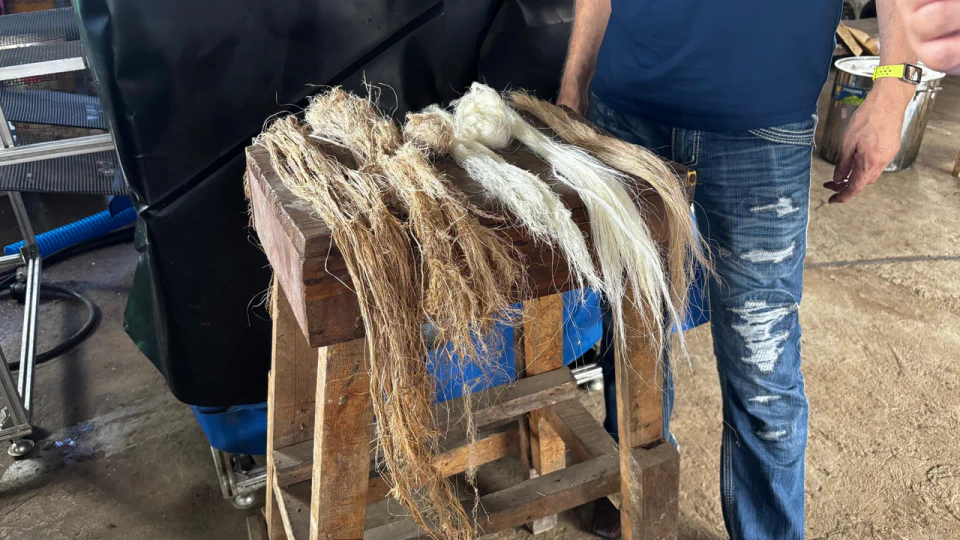
Japanese startup FOOD REBORN conducted a proof of concept in Jakarta that included fiber extraction from unused agricultural waste. Photo: courtesy of the Special Capital Region of Jakarta
“G-NETS is a highly strategic and efficient platform,” she says. “It highlights how cities are working to deliver real solutions to global challenges. For Jakarta itself, this has been a very valuable experience.”
Dewi noted that collaboration with other city leaders, international organizations and private-sector partners has strengthened Jakarta’s position as a credible global partner. The summit has provided concrete benefits for the megacity and allowed it to expand its network with global stakeholders, and explore technologies and innovative solutions.
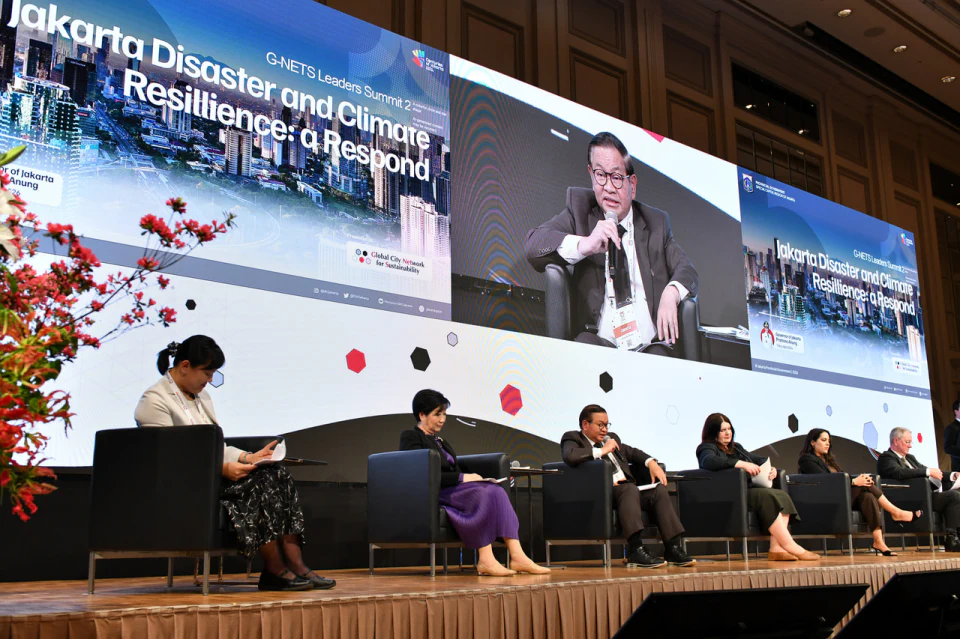
Jakarta Governor Pramono Anung speaking on the Responding to Natural Disasters, one of the session topics under the Resilience category at the 3rd G-NETS Leaders Summit
“We would like to express our appreciation to G-NETS,” says Dewi. “And to the Tokyo Metropolitan Government for inviting us and facilitating practical cooperation, knowledge exchange and pilot initiatives such as the King Salmon Project, which directly contributes to addressing urban challenges in Jakarta.”

Marulina Dewi
Head of the Bureau for Regional and International Cooperation, Jakarta
She has focused on inter-city cooperation on food security programs, strengthening the role of the private sector, and international collaborations, including sister-city partnerships. In 2026, she received the Outstanding Leader in Public Sector Collaboration and Inclusive Governance award at the CNN Indonesia Leading Women Awards.